
SoFi Stadium — Where the All Whites Open Their World Cup
 Available in US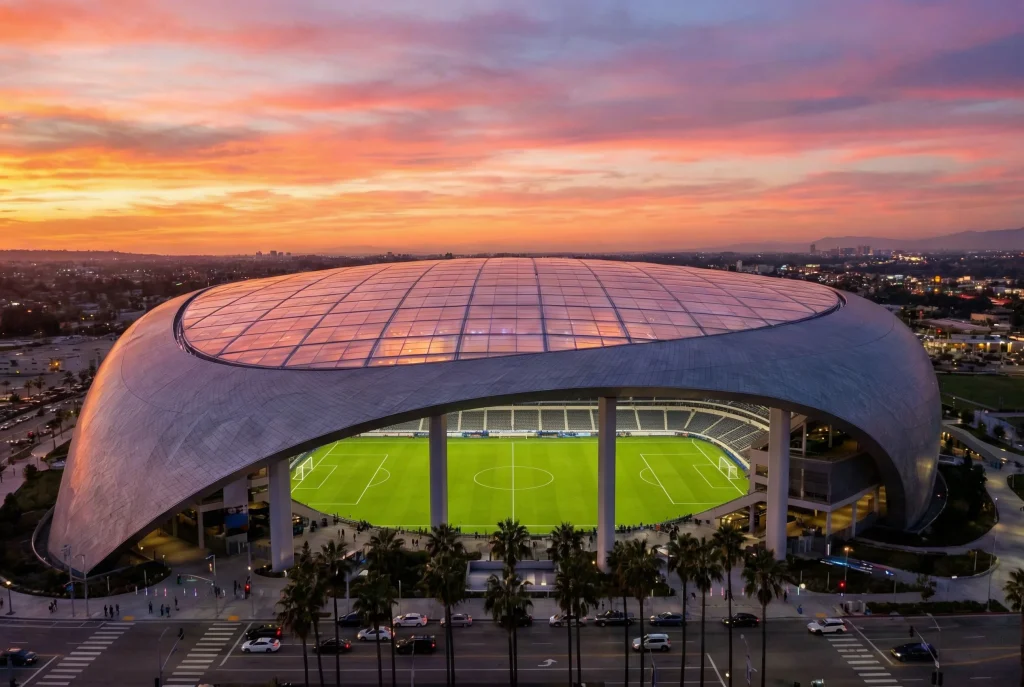
Table of Contents
On 15 June 2026, the All Whites will walk onto the pitch at SoFi Stadium in Los Angeles to face Iran in the opening match of their World Cup 2026 campaign. For every New Zealand football fan who has waited 16 years to see the national team at a World Cup, this is the moment. And the venue matches the occasion. SoFi Stadium is not just a stadium — it is a statement: the most expensive sports venue ever constructed, a USD 5.5 billion monument to what happens when American ambition meets unlimited resources. Whether it feels like a football ground on the night is another question entirely, and one that matters for Kiwi fans planning the trip of a lifetime.
SoFi Stadium — LA’s USD 5.5 Billion Arena
SoFi Stadium opened in September 2020 as the home of two NFL franchises — the Los Angeles Rams and the Los Angeles Chargers — and immediately became the benchmark for modern stadium design. The semi-enclosed structure features a translucent ETFE roof that allows natural light while protecting spectators from direct sun and rain. That roof is a significant advantage over MetLife and other open-air World Cup venues: players and fans at SoFi will not bake in the California sun during afternoon matches. The capacity for World Cup matches will be approximately 70,000, configured for a football pitch that fits neatly within the stadium’s bowl.
The design is cinematic in the literal sense — SoFi was built to host spectacles, and the 70,000-square-foot video board that hangs above the centre of the pitch creates an atmosphere that blends sports with entertainment. For a World Cup match, that video board will display replays, statistics, and crowd shots that amplify the emotional intensity of every moment. The acoustics are engineered for noise retention, and when 70,000 people are generating the kind of fervour that a World Cup group-stage match produces, SoFi will be loud. That matters for the All Whites: if even 5,000 Kiwi fans make the trip to Los Angeles, their voices will carry in a venue designed to amplify crowd sound.
The pitch surface is a point of discussion. SoFi uses a removable natural grass tray system for football events, replacing the artificial turf used for NFL matches. The quality of that surface during a concentrated period of World Cup matches — with multiple fixtures in the space of two weeks — will depend on maintenance and recovery time between events. At the 2022 World Cup in Qatar, pitch conditions deteriorated visibly by the knockout stages, and the North American venues will face similar challenges on a larger scale. For the All Whites’ opening match on 15 June, the surface should be in excellent condition — it is the fixtures later in the tournament that may suffer.
World Cup 2026 Matches at SoFi
SoFi Stadium will host group-stage matches and knockout-round fixtures, making it one of the premier venues of the tournament. The All Whites’ opening match against Iran on 15 June at 21:00 ET — 13:00 NZST on 16 June — is the fixture that puts SoFi on every Kiwi’s radar. The stadium will also host Belgium versus Iran on 21 June, keeping it central to Group G’s storyline throughout the group stage.
The knockout-round matches at SoFi will draw from the tournament’s bracket, and the Los Angeles venue is likely to host at least one quarter-final. That means SoFi could be the stage for one of the tournament’s defining moments — a semi-final upset, a penalty shootout, or a last-minute winner that echoes through World Cup history. The venue has already hosted a Super Bowl in 2022 and will have hosted the 2028 Olympics by the time the football world looks back on 2026 — SoFi is designed for moments that matter.
For punters, the venue characteristics are worth factoring in: the enclosed roof and controlled conditions at SoFi neutralise the weather variable that affects open-air venues, and teams that prefer a fast, passing game will find the surface and atmosphere more conducive than the heat and humidity of the East Coast stadiums. Temperature at pitch level will be consistent regardless of outside conditions, and that predictability is an advantage for teams whose game plans rely on sustained pressing intensity.
The Iran match is the All Whites’ best chance of picking up points in Group G, and the venue could play a role. If New Zealand can generate significant crowd support at SoFi — and the Kiwi community in Southern California, combined with travelling fans, should provide a vocal presence — the atmosphere could tilt the match in our favour during the tight, nervy moments that define group-stage openers. Every small advantage matters when you are the underdog, and a noisy pocket of white-shirted fans in a 70,000-capacity stadium is an advantage worth travelling 10,000 kilometres for.
Los Angeles for Kiwi Football Fans
Los Angeles in mid-June offers exactly what you would expect: sunshine, warmth, and a city that knows how to host an event. SoFi Stadium is located in Inglewood, a suburb south of central LA that has been transformed by the stadium’s presence. The area around the stadium includes restaurants, bars, and entertainment venues that cater to the sports crowd, and on match days, the precinct will be alive with the energy of competing fan groups. Getting to SoFi from central LA is straightforward by car — the stadium is adjacent to the 405 freeway — but traffic in Los Angeles is a phenomenon that defies description for anyone who has not experienced it. On a World Cup match day, the 405 will be at its most challenging, and the advice for any Kiwi fan driving to SoFi is to arrive three hours early and use the tailgating time as part of the experience.
Public transport to SoFi has improved with the opening of the Inglewood Transit Connector, and the Metro’s Crenshaw/LAX Line provides a link from central LA to the stadium area. The journey from Hollywood or downtown takes approximately 40 minutes by train, plus a shuttle or walk from the nearest station. It is not seamless, but it works — and for fans coming from a country where public transport to sports venues is generally reliable, the LA system will require patience and flexibility.
Beyond match days, Los Angeles offers Kiwi travellers a holiday destination in its own right. Santa Monica, Venice Beach, Griffith Observatory, and the hiking trails of the Hollywood Hills are all within easy reach, and the food scene — particularly the Mexican, Korean, and Japanese cuisines that define LA’s culinary landscape — is among the most diverse in the world. A World Cup trip to Los Angeles is not a sacrifice; it is a holiday with football attached. For fans planning to follow the All Whites across their three group matches, the flight from Los Angeles to Vancouver for the BC Place fixtures is approximately three hours — a manageable logistics chain that makes attending all three NZ matches realistic for dedicated supporters.
My SoFi Stadium Rating — 8 out of 10
SoFi Stadium is the best venue the All Whites could have been assigned for their opening match. The enclosed roof eliminates weather concerns, the capacity is large enough to generate genuine atmosphere, and the Los Angeles location provides Kiwi fans with a world-class travel destination surrounding the football. I rate SoFi 8 out of 10 as a World Cup venue — one point deducted for the traffic logistics and one for the fact that, as impressive as SoFi is, it is still an NFL stadium first and a football ground second. The pitch dimensions will feel slightly different to a purpose-built football venue, and the sightlines from the upper tiers may be distant for a sport played on a larger surface than American football. But these are minor quibbles for a venue that delivers on every major criterion. If the All Whites are going to create a World Cup memory that lasts a generation, SoFi Stadium is a worthy stage for it. The journey starts in LA. Make sure you are there to see it.
