
Estadio Azteca — the Legendary Venue Hosting the 2026 Opening Match
 Available in US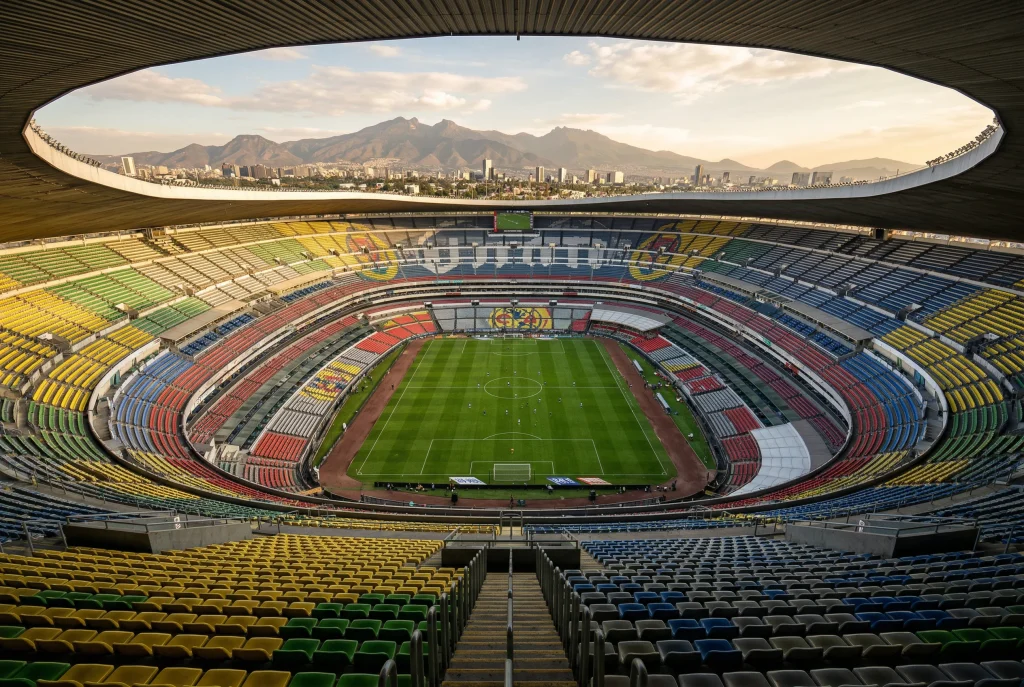
Table of Contents
No stadium in football history has hosted more World Cup matches than Estadio Azteca. Two World Cup finals — 1970 and 1986 — were played on this pitch. Pelé lifted the trophy here. Diego Maradona scored the “Goal of the Century” and the “Hand of God” here. When Mexico versus South Africa kicks off at 15:00 ET on 11 June 2026, Estadio Azteca will become the first venue in history to host matches at three separate World Cups. There is no other ground on earth with that kind of resume, and while the stadium’s age shows in places, the weight of history makes every match played here feel significant before a ball is even kicked.
Estadio Azteca — History on Every Wall
Azteca opened in 1966, originally built for the 1968 Olympics and the 1970 World Cup. The capacity has fluctuated over the decades — at its peak, more than 100,000 spectators packed the terraces for the 1986 World Cup final between Argentina and West Germany. Current capacity sits at approximately 83,000 following renovations that added modern seating, improved sightlines, and upgraded facilities. The stadium is owned by Televisa, Mexico’s largest media conglomerate, and serves as the home ground of Club America, one of the most successful clubs in Mexican football.
The altitude is Azteca’s most distinctive characteristic. Mexico City sits at 2,240 metres above sea level, and the thin air at that elevation affects everything: ball flight, player endurance, recovery times, and tactical approaches. Teams from lowland countries — which includes virtually every European nation at the World Cup — will need acclimatisation time before playing at Azteca, and the opening match’s scheduling gives South Africa limited opportunity to adjust. Mexico, by contrast, have trained and played at altitude for decades. That physiological advantage is real and quantifiable: visiting teams historically concede more goals in the second half at Azteca as fatigue accelerates in the thin air.
The renovation programme ahead of the 2026 World Cup has been extensive. The pitch surface has been relaid, the seating upgraded to meet FIFA’s modern standards, and the infrastructure surrounding the stadium — transport links, security systems, media facilities — has been modernised to handle the demands of a 21st-century World Cup. But Azteca remains, at its core, a 1960s stadium. The concrete bowl, the steep terracing, and the cavernous interior create an atmosphere that modern enclosed stadiums cannot replicate. There is a rawness to Azteca that SoFi and MetLife, for all their technological sophistication, simply do not possess. When the crowd roars at Azteca, the sound comes from everywhere and nowhere. It is the kind of venue that makes players feel small and occasions feel enormous.
World Cup 2026 Matches at Azteca
The opening match — Mexico versus South Africa on 11 June at 15:00 ET — will set the tone for the entire World Cup. Opening ceremonies, global broadcast audiences exceeding a billion viewers, and the pressure of being the first team to play at the tournament combine to create a unique atmosphere that no other group-stage match can replicate. Mexico will be desperate to win in front of their home crowd, and the Azteca faithful will generate a wall of sound that South Africa’s players have never experienced at this scale.
Azteca will host additional group-stage matches and at least one knockout-round fixture, though the stadium’s role in the later stages depends on the bracket. The Mexico City venue is the only one at the tournament located at significant altitude, which means that any match played here carries an inherent environmental variable that punters should factor into their analysis. Teams accustomed to sea-level football will find the first 20 minutes at Azteca manageable, but the cumulative effect of altitude on pressing intensity and sprint recovery becomes apparent from the 60th minute onwards. Any betting model that ignores the altitude factor at Azteca is incomplete.
For Kiwi viewers, the opening match at Azteca kicks off at 15:00 ET on 11 June, which translates to 07:00 NZST on 12 June — a Thursday morning. It is an early start, but as the very first match of the 2026 World Cup, it warrants the alarm clock. The atmosphere at Azteca during a World Cup opening match will be unlike anything else at the tournament, and even through a television screen, the intensity of 83,000 Mexican fans willing their team to victory on the biggest stage in football is an experience worth waking up for.
Mexico City for the World Cup
Mexico City is one of the great cities of the world, and I say that without the qualification that usually accompanies descriptions of Latin American capitals. The food scene alone — from street-side tacos al pastor to fine dining restaurants that rank among the world’s best — justifies a visit regardless of the football. The cultural offerings are staggering: the Museo Nacional de Antropologia, the Frida Kahlo museum, the ruins of Teotihuacan an hour north of the city, and a street art scene that transforms entire neighbourhoods into open-air galleries.
For Kiwi fans considering a broader World Cup trip that combines Mexican and American venues, Mexico City serves as an excellent starting point. The flight from Mexico City to Los Angeles takes approximately four hours, connecting the Azteca opening match to the All Whites’ group-stage matches on the US west coast. Alternatively, flights to Houston, Dallas, and Atlanta are available from Mexico City’s Benito Juarez International Airport with journey times of two to four hours. The logistics of a multi-city World Cup trip across two countries are manageable, provided you book flights early — demand during the tournament will be intense.
Safety in Mexico City is a topic that every Kiwi traveller will research before booking. The reality is nuanced: the tourist areas of Condesa, Roma Norte, Polanco, and the Centro Historico are well-policed and busy with international visitors year-round. Sensible precautions — the same you would take in any major global city — apply. The World Cup will bring an additional security presence that makes the areas around Azteca and the fan zones safer than usual. New Zealanders who have travelled to Melbourne, Bangkok, or London will find the experience comparable: be aware, be sensible, and enjoy one of the most vibrant cities on the planet.
The altitude affects visitors as well as players. Mexico City at 2,240 metres can cause mild altitude sickness — headaches, breathlessness, and fatigue — for those arriving from sea level. The symptoms typically pass within 48 hours, and staying hydrated is the simplest remedy. For Kiwi fans arriving a few days before the opening match, the acclimatisation period doubles as exploration time: take it slow, drink water, and let the city reveal itself at a pace that your body can handle.
My Estadio Azteca Rating — 9 out of 10
Azteca is the most historically significant stadium at the 2026 World Cup, and nothing else comes close. The two previous World Cup finals, the Maradona moments, and the six decades of Mexican football passion embedded in the concrete make this venue a pilgrimage site for anyone who cares about the sport’s history. I deduct one point for the ageing infrastructure — even after renovations, Azteca lacks the comfort and modern amenities of SoFi or MetLife — but that roughness is part of its character. Football was not meant to be experienced in climate-controlled luxury. It was meant to be experienced in noise, heat, altitude, and collective emotion, and Azteca delivers all four in quantities that no other World Cup 2026 venue can match. If the opening match lives up to its setting, it will be one of the enduring images of the tournament.
