
MetLife Stadium — the World Cup 2026 Final Venue
 Available in US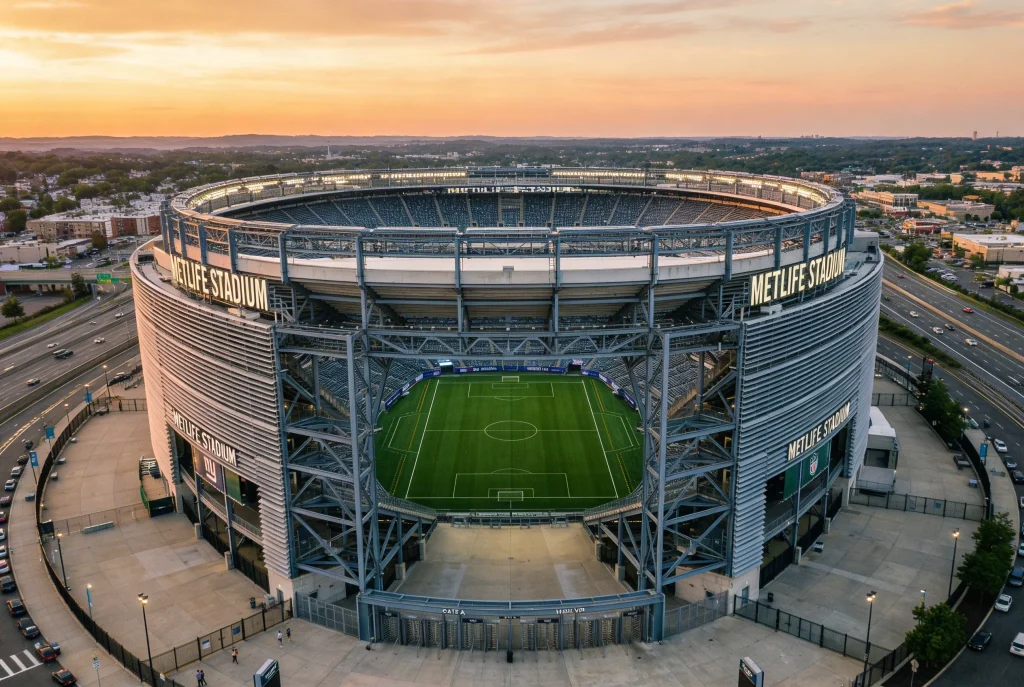
Table of Contents
The biggest match in football will be played in a stadium built for American football, in a suburb of New Jersey, without a roof. That sentence alone tells you everything about the audacity of hosting a World Cup across three countries and 16 venues. MetLife Stadium is not the Maracana. It is not Wembley. It is a 82,500-capacity NFL arena that sits in the Meadowlands, a flat stretch of land between the Hackensack River and the New Jersey Turnpike, roughly 13 kilometres from Times Square. On 19 July 2026, it will host the World Cup final — the most-watched single sporting event on the planet — and every punter, fan, and analyst will have an opinion on whether the venue matches the occasion. Here is mine.
About MetLife Stadium — Numbers and Character
MetLife Stadium opened in 2010 as the shared home of the New York Giants and New York Jets, two NFL franchises that generate the kind of revenue most football clubs can only dream of. The construction cost was approximately USD 1.6 billion — making it one of the most expensive stadiums ever built — and the design prioritises sightlines for American football rather than the wider pitch dimensions of a football match. That is a relevant detail. At the 2026 World Cup, MetLife’s capacity will be configured for football, with temporary adjustments to the pitch dimensions and seating layouts. The result will be a stadium that feels enormous — because it is — but potentially lacks the intimacy that defines the great European and South American football venues.
The stadium has no roof and no retractable cover. In July, the New Jersey climate delivers average temperatures around 30 degrees Celsius with high humidity, and afternoon thunderstorms are common during the summer months. The World Cup final at 15:00 ET on 19 July means players will be competing in mid-afternoon heat, and the lack of shade for spectators in the upper tiers will be a significant comfort issue. For a tournament that has spoken extensively about player welfare and optimal conditions, scheduling the final in an open-air stadium during peak New Jersey summer is a choice that invites scrutiny.
I have attended NFL matches at MetLife, and the atmosphere is overwhelming in the American tradition — loud, commercial, and relentlessly energetic. Whether that translates to a football atmosphere depends entirely on who plays in the final. If Argentina or Brazil are involved, the diaspora communities in the New York metropolitan area will fill the stadium with colour and noise that rivals any venue in the world. If the final is between two European sides, the atmosphere may feel more corporate — MetLife’s premium seating, corporate suites, and sponsored zones are designed for American sports culture, and the football world’s expectations of a final venue may clash with that reality.
World Cup 2026 Matches at MetLife
MetLife Stadium will host group-stage matches, knockout-round fixtures, and the final itself — a full schedule that makes it one of the busiest venues at the tournament. The group-stage matches will provide the first test of how the stadium handles football crowds, and the atmosphere during those early fixtures will set expectations for the matches that follow. From a punting perspective, the venue’s characteristics matter. The open-air design, the July heat, and the potentially slow pitch surface — NFL turf converted for football — could favour teams that rely on defensive organisation and counter-attacking speed over high-pressing, energy-intensive systems.
The knockout-round matches at MetLife will carry increasing stakes, and the East Rutherford location — accessible from New York City via public transport, though the journey involves a combination of trains and shuttles that would test the patience of even the most seasoned commuter — means that neutral fans from across the tri-state area will fill any seats not taken by the competing nations’ supporters. The final on 19 July will be the culmination of 39 days of football, and MetLife’s role as the venue for that climax ensures that every detail — the pitch quality, the weather, the atmosphere — will be scrutinised under a global microscope.
For Kiwi fans, the final kicks off at 15:00 ET, which converts to 07:00 NZST on 20 July — a Sunday morning. That is the most watchable possible time for a World Cup final from New Zealand. Alarm clocks at 06:30, coffee on, and the world’s biggest football match over breakfast. If the All Whites have somehow defied every prediction and reached the later knockout rounds, the MetLife matches will be front-page news across the country. Even if — more realistically — our World Cup ends in the group stage, the final remains appointment viewing.
East Rutherford and New York — the Matchday Experience
MetLife Stadium sits in the Meadowlands Sports Complex, a purpose-built sporting precinct that includes the stadium, a horse-racing track, and acres of car parking designed for the American tradition of pre-match tailgating. For international visitors — and particularly for Kiwi fans who might combine a World Cup trip with a New York holiday — the location is both convenient and disorienting. The stadium is technically in New Jersey, not New York, and the surrounding area offers none of the urban buzz that Manhattan provides. On a match day, the Meadowlands is entirely about the event: you arrive, you enter, you watch, you leave.
Getting to MetLife from Manhattan involves the NJ Transit train from Penn Station to Secaucus Junction, followed by a shuttle to the stadium — a journey of roughly 45 minutes that can stretch considerably on match days. The alternative is driving, but parking near the stadium on a World Cup final day will be logistically challenging and expensive. For anyone planning a trip from New Zealand, my advice is simple: book accommodation in Manhattan, allow at least two hours for the journey to MetLife, and treat the stadium experience as a day trip from the city rather than a destination in itself.
New York City itself needs no introduction, but for Kiwi football fans, the city offers something specific during the World Cup: fan zones, public screenings, and a multinational atmosphere that turns every bar and park into a potential viewing venue. The New York metro area is home to enormous diaspora communities from virtually every World Cup nation, and the weeks surrounding the final will transform the city into an unofficial global football capital. The energy in neighbourhoods like Jackson Heights (home to South American communities), Astoria (European diaspora), and Harlem (African and Caribbean communities) will be electric on match days.
If you cannot get a ticket to the final at MetLife, watching it in a New York sports bar surrounded by fans from every continent is a credible alternative. The shared experience of a World Cup final in a city that never sleeps is, in many ways, more memorable than the stadium experience itself — and considerably cheaper. For Kiwi travellers combining a World Cup trip with a broader American holiday, New York in July offers baseball at Yankee Stadium, Broadway shows, and a culinary scene that has no parallel. The football is the reason you go. The city is the reason you stay.
My MetLife Stadium Rating — 7 out of 10
MetLife Stadium is a venue that divides opinion, and I understand both sides. On one hand, it is big, it is accessible from the world’s most famous city, and it will generate the global broadcast audience that a World Cup final demands. On the other, it lacks the architectural soul of a purpose-built football stadium, the open-air July conditions are a genuine concern for player performance and spectator comfort, and the matchday experience at the Meadowlands is industrial rather than inspirational. I rate MetLife 7 out of 10 as a World Cup final venue. It would score higher with a roof and lower without the New York proximity. The location saves it — being 13 kilometres from Manhattan means the final will feel like a global event rather than a suburban one, and the diversity of the crowd will be unlike any World Cup final in history. For punters analysing the final, the venue is a factor: the heat, the open air, and the surface could favour certain playing styles over others, and any team that reaches the final through a physically demanding bracket may feel the effects of the conditions more acutely. This is a venue that rewards freshness, fitness, and tactical intelligence over raw energy.
